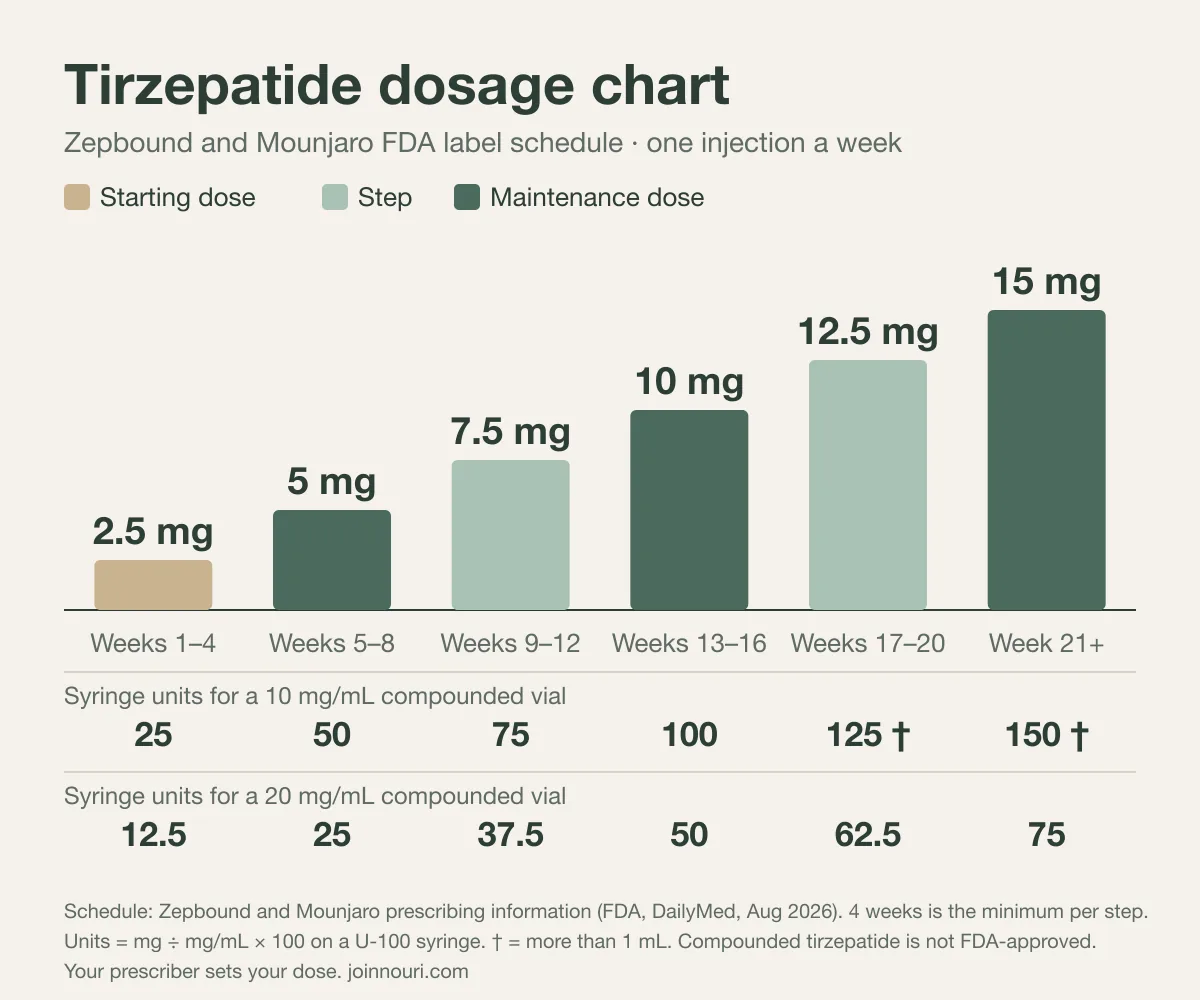
The short answer: Tirzepatide starts at 2.5 mg once weekly for 4 weeks, then rises in 2.5 mg steps of at least 4 weeks to a 15 mg maximum. Maintenance doses are 5, 10 or 15 mg (Zepbound and Mounjaro FDA labels, August 2026). On a compounded vial, units = mg ÷ mg/mL × 100: 2.5 mg is 25 units at 10 mg/mL. Your prescriber sets your dose; compounded tirzepatide is not FDA-approved.
Convert your tirzepatide dose to units →
What is the standard tirzepatide dosing schedule?
| Weeks | Weekly dose | Role |
|---|---|---|
| 1–4 | 2.5 mg | Starting dose only |
| 5–8 | 5 mg | Maintenance dose option |
| 9–12 | 7.5 mg | Step |
| 13–16 | 10 mg | Maintenance dose option |
| 17–20 | 12.5 mg | Step |
| 21+ | 15 mg | Maximum maintenance dose |
The weeks are the fastest pace the label allows; holding a dose longer is common. Nausea and other GI effects peak after each step-up (see tirzepatide side effects), and the label allows a lower maintenance dose when a step isn't tolerated.
Tirzepatide dosage chart in units: how many units is each dose?
Compounded tirzepatide comes in a multi-dose vial drawn with a U-100 insulin syringe. Find your prescribed dose (row) and the mg/mL on your vial label (column).
| Dose | 5 mg/mL | 10 mg/mL | 12.5 mg/mL | 15 mg/mL | 17 mg/mL | 20 mg/mL | 25 mg/mL |
|---|---|---|---|---|---|---|---|
| 2.5 mg | 50 units 0.5 mL | 25 units 0.25 mL | 20 units 0.2 mL | 16.7 units 0.167 mL | 14.7 units 0.147 mL | 12.5 units 0.125 mL | 10 units 0.1 mL |
| 5 mg | 100 units 1 mL | 50 units 0.5 mL | 40 units 0.4 mL | 33.3 units 0.333 mL | 29.4 units 0.294 mL | 25 units 0.25 mL | 20 units 0.2 mL |
| 7.5 mg | 150 units † 1.5 mL | 75 units 0.75 mL | 60 units 0.6 mL | 50 units 0.5 mL | 44.1 units 0.441 mL | 37.5 units 0.375 mL | 30 units 0.3 mL |
| 10 mg | 200 units † 2 mL | 100 units 1 mL | 80 units 0.8 mL | 66.7 units 0.667 mL | 58.8 units 0.588 mL | 50 units 0.5 mL | 40 units 0.4 mL |
| 12.5 mg | 250 units † 2.5 mL | 125 units † 1.25 mL | 100 units 1 mL | 83.3 units 0.833 mL | 73.5 units 0.735 mL | 62.5 units 0.625 mL | 50 units 0.5 mL |
| 15 mg | 300 units † 3 mL | 150 units † 1.5 mL | 120 units † 1.2 mL | 100 units 1 mL | 88.2 units 0.882 mL | 75 units 0.75 mL | 60 units 0.6 mL |
Units = dose (mg) ÷ strength (mg/mL) × 100. Recheck the mg/mL at every refill: pharmacies change strengths between batches. Swipe the table sideways on a phone.
The FDA has reported patients drawing 5–20 times their dose after mixing up units, mL and mg.
Dose or strength not listed? Our free tirzepatide dose calculator converts any prescribed dose at any strength and shows the syringe. For other vials, use the mg to units calculator.
What if your vial says 10, 30 or 60 mg?
That is the vial's total, not its strength. Strength (mg/mL) = total mg ÷ mL of liquid, so the same 30 mg vial gives different units at 1 mL or 2 mL.
| Vial label | 2.5 mg | 5 mg | 7.5 mg | 10 mg |
|---|---|---|---|---|
| 10 mg / 1 mL 10 mg/mL | 25 | 50 | 75 | 100 |
| 30 mg / 2 mL 15 mg/mL | 16.7 | 33.3 | 50 | 66.7 |
| 60 mg / 3 mL 20 mg/mL | 12.5 | 25 | 37.5 | 50 |
| 60 mg / 2.4 mL 25 mg/mL | 10 | 20 | 30 | 40 |
Doses per vial = total mg ÷ your dose: a 30 mg vial holds six 5 mg doses, within the pharmacy's beyond-use date.
Can you stay at 5 mg of tirzepatide long-term?
Yes. For weight management, 5, 10 and 15 mg are all approved maintenance doses; 7.5 and 12.5 mg are steps only.
How is Mounjaro's schedule different?
Mounjaro, the type 2 diabetes label, uses the same 2.5–15 mg doses and 4-week minimums, but steps up only when more blood-sugar control is needed.
What happens if you miss a dose of tirzepatide?
- Within 4 days (96 hours): take it, then keep your usual day.
- After 4 days: skip it. Never double up.
Two doses must be at least 3 days (72 hours) apart. After several missed weeks, ask your prescriber where to restart.
Is tirzepatide stronger than semaglutide?
In SURMOUNT-5, branded tirzepatide averaged 20.2% weight loss at 72 weeks versus 13.7% on semaglutide 2.4 mg; compounded versions were not studied. The doses don't convert mg for mg, so moving from semaglutide to tirzepatide means starting at 2.5 mg. Compare compounded semaglutide vs tirzepatide and compounded tirzepatide vs Zepbound, or see the semaglutide dosage chart.
Does tirzepatide cost more at higher doses?
At some providers, yes: per-dose pricing raises the bill at each step (see the tirzepatide cost breakdown). Compare tirzepatide prices from licensed providers, or read how tirzepatide telehealth prescribing works.
Frequently asked questions
How long do you stay on 2.5 mg of tirzepatide?
Four weeks. 2.5 mg is a starting dose only; the label then moves to 5 mg.
When do you move up to the next dose?
After at least 4 weeks on the current dose, if your prescriber decides more effect is needed and you tolerate the step.
What is the maximum dose of tirzepatide?
15 mg once weekly, for Zepbound and adult Mounjaro.
What happens if you miss a dose of tirzepatide?
Take it within 4 days (96 hours); after that, skip it and keep your usual day. Never double up.
How many units is 2.5 mg of compounded tirzepatide?
25 units at 10 mg/mL, 14.7 units at 17 mg/mL and 12.5 units at 20 mg/mL on a U-100 syringe. Use the mg/mL printed on your own vial.
How many units is 5 mg of tirzepatide?
50 units at 10 mg/mL, 33.3 at 15 mg/mL, 29.4 at 17 mg/mL, 25 at 20 mg/mL and 20 at 25 mg/mL.
How many mg is 20 units of tirzepatide?
20 units is 0.2 mL: 2 mg at 10 mg/mL, 3.4 mg at 17 mg/mL, 4 mg at 20 mg/mL, 5 mg at 25 mg/mL.
How many mg is 40 units of tirzepatide?
40 units is 0.4 mL: 4 mg at 10 mg/mL, 6.8 mg at 17 mg/mL, 8 mg at 20 mg/mL, 10 mg at 25 mg/mL.
Is the dosing schedule the same for Zepbound and Mounjaro?
The doses and 4-week steps are the same. Zepbound climbs toward a 5, 10 or 15 mg maintenance dose; Mounjaro steps up only when blood sugar needs it.
How do you switch from semaglutide to tirzepatide?
Start tirzepatide at 2.5 mg and step up as prescribed. The two drugs do not convert mg for mg.
Sources
- Zepbound (tirzepatide) Prescribing Information — DailyMed, effective August 28, 2026 (checked Oct 18, 2026). dailymed.nlm.nih.gov
- Mounjaro (tirzepatide) Prescribing Information — DailyMed, effective August 27, 2026 (checked Oct 18, 2026). dailymed.nlm.nih.gov
- Jastreboff AM et al. Tirzepatide once weekly for the treatment of obesity (SURMOUNT-1). NEJM 2022. nejm.org
- Aronne LJ et al. Tirzepatide as compared with semaglutide for the treatment of obesity (SURMOUNT-5). NEJM 2025. nejm.org
- FDA press announcement — first medication approved for obstructive sleep apnea (Zepbound), December 2024. fda.gov
- FDA alert — dosing errors associated with compounded injectable GLP-1 medications, July 2024. fda.gov
- FDA — Compounding and the FDA: Questions and Answers. fda.gov
Compounded tirzepatide is not FDA-approved, has not been evaluated by the FDA for safety, effectiveness or quality, and is not therapeutically equivalent to Zepbound or Mounjaro. This page summarizes the FDA labels and converts doses already prescribed; it is not medical advice. Nouri does not prescribe, dispense, or sell medication.
Medical Disclaimer: This article is for informational purposes only and does not constitute medical advice. Always consult with a qualified healthcare provider before starting or changing any medication or treatment. Licensed providers review patient assessments before making clinical decisions.
Begin your wellness journey today
Personalized wellness plans from licensed providers. Free shipping. 100% online.