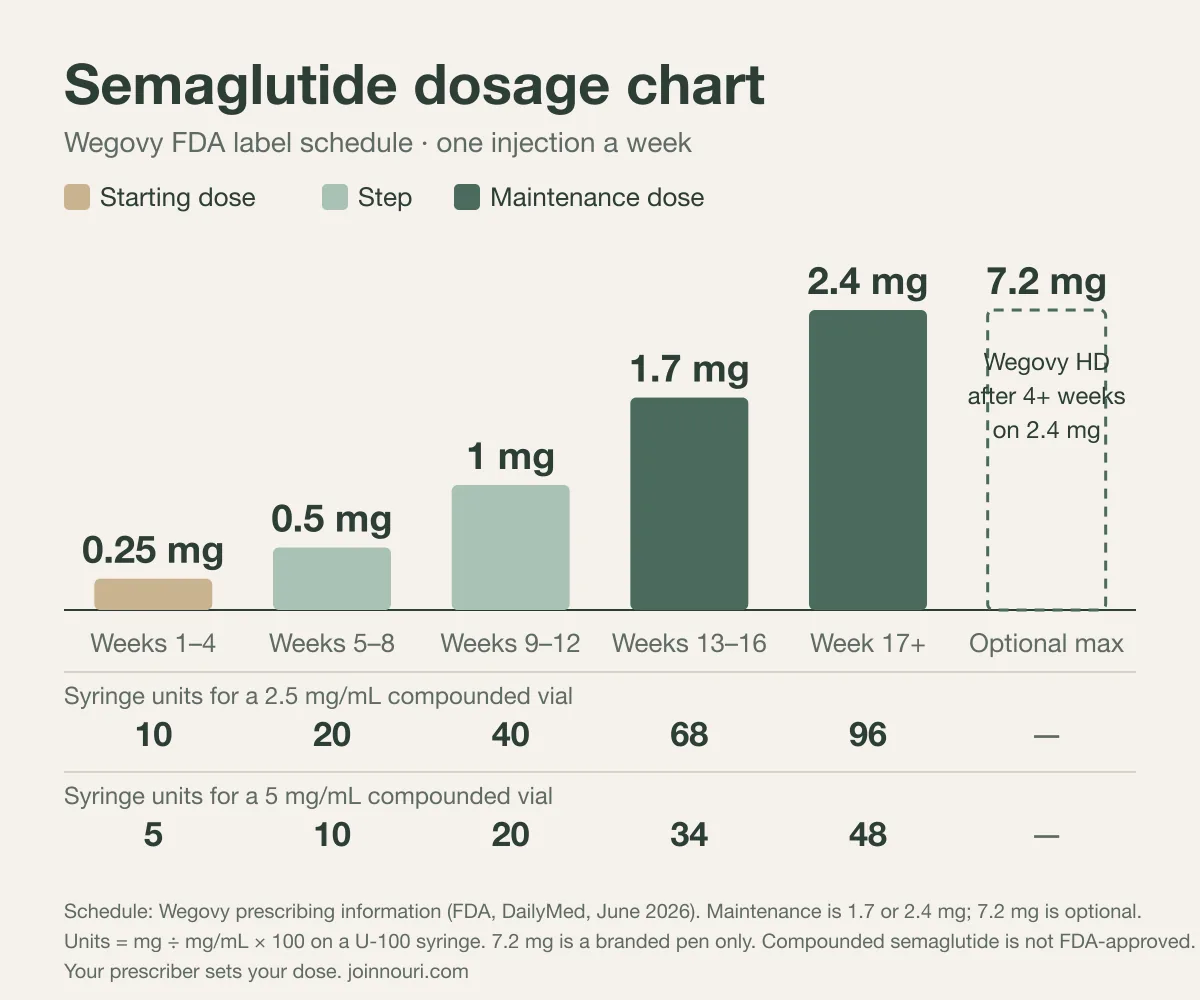
The short answer: The Wegovy FDA label (June 2026) begins semaglutide at 0.25 mg a week and climbs through 0.5, 1 and 1.7 mg, a month per step, to 1.7 or 2.4 mg for maintenance. Adults on 2.4 mg can now go to 7.2 mg (Wegovy HD, March 2026). Drawing from a compounded vial? Divide the dose by the vial's mg/mL and multiply by 100 for syringe units, so 0.25 mg at 2.5 mg/mL is 10 units. Dosing is your prescriber's decision, and compounded semaglutide is not FDA-approved.
Convert your semaglutide dose to units →
What is the standard semaglutide dosing schedule?
| Week | Dose, once a week | Purpose |
|---|---|---|
| 1–4 | 0.25 mg | Tolerance-building start |
| 5–8 | 0.5 mg | Escalation |
| 9–12 | 1 mg | Escalation |
| 13–16 | 1.7 mg | Step, also a maintenance dose |
| 17+ | 1.7 or 2.4 mg | Maintenance (2.4 mg recommended for adults) |
| Optional | 7.2 mg | Adults who tolerated 2.4 mg for 4+ weeks |
Each step lasts at least 4 weeks, and the label allows delaying a step another 4 weeks if it isn't tolerated. GI effects such as semaglutide nausea peak after each increase.
How many units of semaglutide? Dosage chart in units
Pharmacies dispense compounded semaglutide in a multi-dose vial, and you measure every injection yourself. Pick the row for your prescribed dose, then the column matching the strength on your label.
| Dose | 1 mg/mL | 2 mg/mL | 2.5 mg/mL | 5 mg/mL | 10 mg/mL |
|---|---|---|---|---|---|
| 0.25 mg | 25 units 0.25 mL | 12.5 units 0.125 mL | 10 units 0.1 mL | 5 units 0.05 mL | 2.5 units 0.025 mL |
| 0.5 mg | 50 units 0.5 mL | 25 units 0.25 mL | 20 units 0.2 mL | 10 units 0.1 mL | 5 units 0.05 mL |
| 1 mg | 100 units 1 mL | 50 units 0.5 mL | 40 units 0.4 mL | 20 units 0.2 mL | 10 units 0.1 mL |
| 1.7 mg | 170 units † 1.7 mL | 85 units 0.85 mL | 68 units 0.68 mL | 34 units 0.34 mL | 17 units 0.17 mL |
| 2 mg | 200 units † 2 mL | 100 units 1 mL | 80 units 0.8 mL | 40 units 0.4 mL | 20 units 0.2 mL |
| 2.4 mg | 240 units † 2.4 mL | 120 units † 1.2 mL | 96 units 0.96 mL | 48 units 0.48 mL | 24 units 0.24 mL |
| 2.5 mg | 250 units † 2.5 mL | 125 units † 1.25 mL | 100 units 1 mL | 50 units 0.5 mL | 25 units 0.25 mL |
Every figure is milligrams over concentration, times 100. 2 mg is included because it is Ozempic's ceiling; Wegovy HD's 7.2 mg is a branded pen only. Strengths can change from batch to batch: read the label each refill.
The FDA has documented hospitalizations from compounded semaglutide drawn at 10 times the intended dose, such as 50 units instead of 5.
Need a dose this grid skips? Type it into the free semaglutide dose calculator, which works both ways (mg to units, units to mg). Any other medication: the mg to units calculator.
How is Ozempic's schedule different?
Ozempic (type 2 diabetes) tops out lower: 0.25 mg for a month, then 0.5 mg, then optional 1 mg and 2 mg steps if glucose stays high.
What changed in 2026: the 7.2 mg maximum
Wegovy HD, approved in March 2026, is 7.2 mg once weekly: a direct step from 2.4 mg, with no dose in between. In the STEP UP trial, branded 7.2 mg averaged about 20.7% weight loss, and 22% of participants reported skin-sensation changes (dysesthesia) versus 6% at 2.4 mg.
What happens if you miss a dose of semaglutide?
- Over 48 hours until the next dose: inject as soon as you remember.
- Under 48 hours: skip and wait; no doubling.
- 2+ consecutive misses: the label says restart escalation lower.
Ozempic allows 5 days. Changing your injection day is allowed if doses stay 48 hours apart.
Is semaglutide more expensive at higher doses?
Depending on the provider, yes (see the semaglutide cost breakdown). Compare semaglutide prices from licensed providers, read about getting semaglutide online, or use our checklist for vetting semaglutide providers. Switching drugs? See the tirzepatide dosage chart.
Frequently asked questions
Can you stay on a lower dose of semaglutide if it's working?
Yes. 1.7 mg is an approved maintenance dose, and going higher is a clinical choice, not a requirement.
What is the maximum dose of semaglutide?
7.2 mg once weekly for weight management (Wegovy HD, since March 2026) and 2 mg for Ozempic. Compounded prescriptions usually top out at 2.4–2.5 mg.
Does the 0.25 mg starting dose of semaglutide cause weight loss?
It is not meant to. 0.25 mg is a 4-week starting dose that builds GI tolerance.
What happens if I miss a dose of semaglutide?
If the next one is over 48 hours away, inject now; if not, skip. Two or more missed in a row means restarting lower, per your prescriber.
How many units is 0.25 mg of compounded semaglutide?
25 units at 1 mg/mL, 10 at 2.5 mg/mL, 5 at 5 mg/mL. Go by the strength on your own label, not anyone else's.
How many units is 1 mg of semaglutide?
100 units at 1 mg/mL, 50 at 2 mg/mL, 40 at 2.5 mg/mL, 20 at 5 mg/mL and 10 at 10 mg/mL.
How many mg is 10 units of semaglutide?
10 units is 0.1 mL: 0.1 mg at 1 mg/mL, 0.25 mg at 2.5 mg/mL, 0.5 mg at 5 mg/mL, 1 mg at 10 mg/mL.
Can I change my semaglutide injection day?
Yes, as long as two doses stay at least 48 hours apart.
Sources
- Wegovy (semaglutide) Prescribing Information — DailyMed, effective June 18, 2026 (checked Oct 18, 2026). dailymed.nlm.nih.gov
- Ozempic (semaglutide) Prescribing Information — DailyMed. dailymed.nlm.nih.gov
- FDA press announcement — approval of higher-dose semaglutide (7.2 mg), March 2026. fda.gov
- Wilding JPH et al. Once-weekly semaglutide in adults with overweight or obesity (STEP 1). NEJM 2021. nejm.org
- STEP UP trial — semaglutide 7.2 mg in obesity. Lancet Diabetes & Endocrinology 2025. thelancet.com
- Blundell J et al. Effects of once-weekly semaglutide on appetite and energy intake. Diabetes Obes Metab 2017. pubmed.ncbi.nlm.nih.gov
- FDA, July 2024: dosing-error alert for compounded injectable semaglutide. fda.gov
- FDA Q&A on drug compounding. fda.gov
Compounded semaglutide has no FDA approval: the agency has not reviewed it for safety, effectiveness or quality, and it is not a therapeutic equivalent of Wegovy or Ozempic. Everything here comes from the FDA labels and published trials, and the units chart only converts a dose your prescriber chose. Not medical advice; Nouri is a publisher and does not prescribe or sell any medication.
Medical Disclaimer: This article is for informational purposes only and does not constitute medical advice. Always consult with a qualified healthcare provider before starting or changing any medication or treatment. Licensed providers review patient assessments before making clinical decisions.
Begin your wellness journey today
Personalized wellness plans from licensed providers. Free shipping. 100% online.