
An adaptive treatment plan is defined as a dynamic, closed-loop clinical strategy that continuously integrates patient data to refine interventions in near real-time, rather than following a fixed, static protocol. This approach applies across oncology, mental health, and digital therapeutics, replacing one-size-fits-all care with individualized adjustments driven by measurable changes in a patient’s condition. Understanding the adaptive treatment plan definition matters whether you are a clinician designing a care pathway or a patient trying to understand why your treatment looks different from someone else’s with the same diagnosis. The core principle is straightforward: your treatment evolves as you do.
What does an adaptive treatment plan mean in clinical practice?
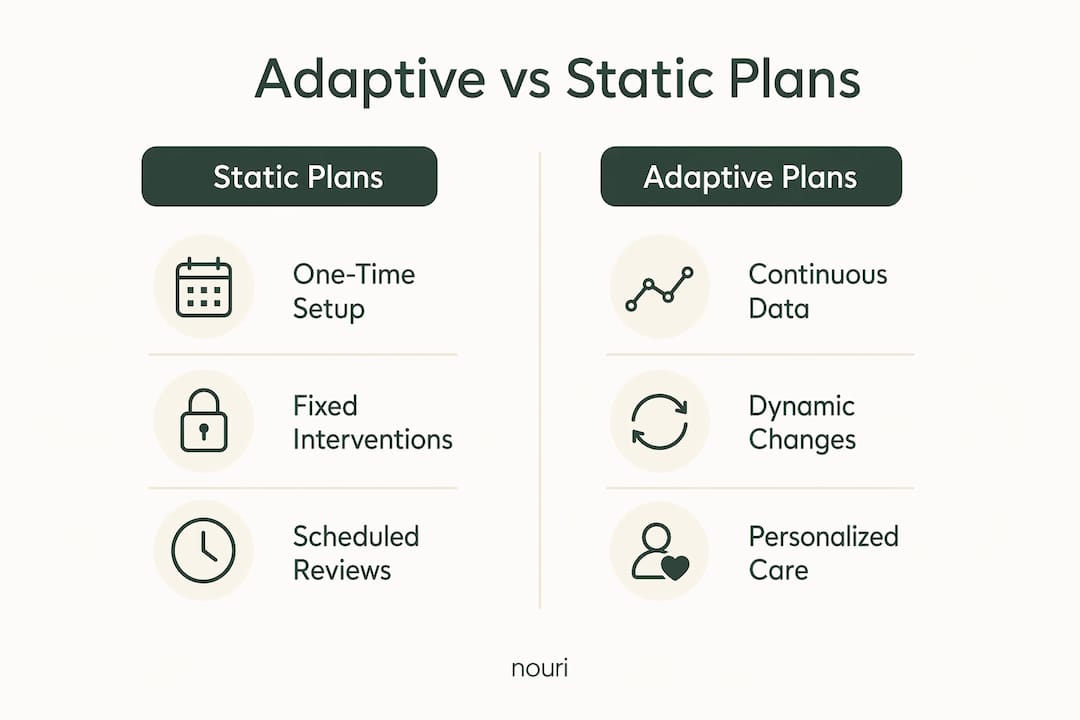
An adaptive treatment plan, also called an Adaptive Treatment Strategy (ATS) or Just-In-Time Adaptive Intervention (JITAI) in behavioral health research, is a structured protocol that uses ongoing patient data to guide when and how treatment is modified. The key distinction from conventional care is that adaptation is built into the protocol itself, not left to ad hoc clinical judgment.
Static treatment plans assign a fixed intervention at the start of care and update it only at scheduled review points, such as quarterly appointments. Adaptive plans, by contrast, use continuous data streams, including symptom scores, imaging results, lab values, and patient-reported outcomes, to trigger adjustments between those scheduled visits.

The clinical benefit is precision. A patient’s tumor volume changes during radiation therapy. A patient’s depression severity fluctuates week to week. A patient’s weight and metabolic response shift during GLP-1 therapy. Static plans cannot account for these changes in real time. Adaptive strategies are specifically designed to respond to them.
Three core elements define any adaptive treatment plan:
- Real-time or near real-time data integration: Measurements are collected frequently, often daily, and fed directly into clinical decision-making.
- Pre-specified decision rules: Adaptations are not arbitrary. They follow defined criteria, such as “if tumor volume decreases by X%, reduce the treatment field.”
- Physician-in-the-loop oversight: Recalculated plans require clinician review and approval before any change is delivered to the patient.
Pro Tip: When evaluating whether a treatment program is truly adaptive, ask your care team what data triggers a plan change and how frequently those triggers are reviewed. A genuine adaptive protocol has written decision rules, not just general clinical flexibility.
How does adaptive radiotherapy work for cancer treatment?
Adaptive Radiotherapy (ART) is the most clinically mature example of an adaptive treatment plan in use today. The process centers on re-evaluating a patient’s anatomy on the treatment couch before every radiation fraction, then recalculating the delivery plan to match the patient’s current physical state.
Traditional radiation therapy plans are designed once, at the start of treatment, based on a single CT scan. The patient’s body changes over the course of treatment. Bladder filling shifts. Tumors shrink. Weight loss alters tissue geometry. A plan designed on day one may be delivering dose to the wrong location by week four.
ART corrects for this by acquiring daily imaging, typically cone-beam CT or MRI, immediately before each session. Dosimetrists and physicists recalculate the plan based on that day’s anatomy. The treating physician reviews and approves the adapted plan before delivery begins. This physician approval process is non-negotiable. No adapted plan is delivered without explicit clinical sign-off.
The clinical impact is significant. ART enables hypofractionation, which reduces treatment courses from the traditional 20–45 sessions down to typically 5 sessions. That reduction is possible because daily recalibration maintains sub-millimeter targeting accuracy throughout the shortened course.
| Feature | Traditional Radiotherapy | Adaptive Radiotherapy |
|---|---|---|
| Planning frequency | Once, at treatment start | Before every fraction |
| Imaging | Single baseline CT | Daily cone-beam CT or MRI |
| Session count | 20–45 sessions | Typically 5 sessions |
| Anatomical adjustment | None after planning | Daily recalibration |
| Physician review | At planning only | Before every adapted delivery |
Pro Tip: Patients undergoing ART should ask their radiation oncology team whether their center uses online adaptive planning, meaning recalculation happens while they are on the couch, or offline adaptive planning, where changes are applied the following day. Online ART offers the most precise daily correction.
The reduction in session count carries practical weight for patients. Fewer trips to a treatment center, less cumulative fatigue, and lower overall treatment burden. Research supports that this reduction does not compromise accuracy. The targeting precision achieved through daily recalibration is what makes the shorter course clinically defensible.
How are adaptive plans used in mental health and digital therapeutics?
Adaptive treatment plans extend well beyond oncology. In mental health care, the same closed-loop logic applies to therapy delivery, medication titration, and digital therapeutic programs.
Digital therapeutics platforms use daily status measurement, including patient-reported mood scores, sleep quality, and engagement metrics, to adjust the content and intensity of therapeutic interventions between clinician visits. This is not simply sending a reminder at a different time. Content-level personalization means the actual therapeutic material, the exercises, the cognitive restructuring prompts, the psychoeducation modules, changes based on where the patient is clinically on any given day.
The Dynamic Personalized Optimization (DPO) framework, described in peer-reviewed literature published in JMIR Medical Informatics, formalizes this approach. DPO uses closed-loop feedback cycles with daily reported feelings and engagement metrics to make micro-adjustments that prevent stagnant, one-size-fits-all care and improve long-term patient engagement.
Key features of adaptive mental health treatment plans include:
- Daily symptom monitoring: Patients report mood, anxiety, or functioning scores through structured check-ins, generating the data that drives adaptation.
- Threshold-based escalation: If scores cross a pre-defined threshold, the system flags the case for clinician review or intensifies therapeutic content within approved parameters following clinician review.
- Maintenance-to-intensive transitions: Patient response heterogeneity means that what works during an acute phase may not sustain remission. Adaptive plans manage these transitions deliberately.
- Clinician oversight at decision points: Recommended changes are reviewed by licensed clinicians before they are implemented, preserving the therapeutic relationship and clinical accountability.
The practical advantage over static mental health protocols is engagement. Patients receiving content that matches their current clinical state are more likely to complete treatment and less likely to disengage when initial symptom relief creates a false sense of recovery.
What are the main challenges of implementing adaptive treatment plans?
Adaptive treatment plans carry genuine clinical advantages, but their implementation introduces challenges that clinicians and health systems must address directly.
-
Time constraints in on-couch recalculation. The time-constraint gap is a documented challenge in adaptive radiotherapy. Recalculating a treatment plan while a patient lies on the treatment couch requires speed without sacrificing accuracy. Physicians must review and approve the adapted plan within a narrow window. This demands highly trained teams and purpose-built workflows.
-
Maintaining human oversight without slowing care. Adaptive systems generate recommendations faster than traditional clinical review cycles. The risk is that teams either slow the process to unsustainable levels by reviewing every micro-adjustment, or they over-delegate to system-generated recommendations without adequate scrutiny. Neither extreme is acceptable. The human-in-the-loop requirement must be preserved without becoming a bottleneck.
-
Managing patient response heterogeneity. Patients respond differently to the same intervention, and their responses change over time. Adaptive plans must be designed to handle this variability, not just optimize for an average response. Decision rules need to account for outliers and edge cases.
-
Treatment burden versus adherence. More frequent data collection and more frequent clinical interactions can increase patient burden. If the adaptive protocol requires daily check-ins that feel onerous, adherence drops and the data quality that drives adaptation degrades.
-
Workflow integration across clinical teams. Adaptive plans require coordination between physicians, dosimetrists, therapists, data systems, and patients. Siloed workflows undermine the closed-loop feedback that makes adaptation possible.
Pro Tip: Clinicians implementing adaptive protocols for the first time should pilot the workflow with a small patient cohort before full rollout. Identifying the time-constraint bottlenecks and data handoff gaps in a controlled setting prevents those issues from affecting patient safety at scale.
How do adaptive treatment plans improve patient outcomes?
The patient-facing benefits of adaptive treatment plans are measurable and clinically meaningful across multiple domains.
In oncology, daily anatomical recalibration in ART reduces radiation dose to healthy surrounding tissue. This translates to lower rates of acute toxicity, fewer treatment interruptions, and better quality of life during and after treatment. The ability to deliver fewer treatment sessions without compromising tumor control directly reduces the logistical and financial burden on patients, particularly those traveling significant distances for care.
“Adaptive radiotherapy’s key benefit is enabling hypofractionation, which significantly reduces treatment burden while keeping targeting accuracy high.” — 5D Cancer Services, Evidence-Based Guide to Adaptive Radiotherapy
In mental health, patients receiving adaptive digital therapeutic interventions show higher rates of sustained engagement compared to those on static protocols. The reason is clinical fit. When therapy content matches a patient’s current state rather than their state at intake, the intervention remains relevant throughout the treatment course.
Across both domains, the common thread is that adaptive plans reduce the gap between what a treatment was designed to do and what a patient actually needs on any given day. That gap is where treatment failures, dropouts, and adverse events accumulate in static care models.
Key takeaways
Adaptive treatment plans outperform static protocols because they respond to real patient data at the point of care, not at the next scheduled review.
| Point | Details |
|---|---|
| Core definition | Adaptive plans use continuous patient data and pre-specified rules to adjust interventions in near real-time. |
| Radiotherapy application | ART reduces treatment sessions from up to 45 down to typically 5 by recalibrating daily to anatomical changes. |
| Mental health application | Digital therapeutics use closed-loop feedback to adjust therapy content, not just timing, based on daily symptom data. |
| Physician oversight | Every adapted plan requires clinician review and approval before delivery, regardless of how the recommendation is generated. |
| Implementation challenge | The time-constraint gap and patient response heterogeneity are the two most common barriers to successful adaptive plan adoption. |
Why the shift to adaptive care is overdue
Reviewing how treatment protocols are designed and how they actually perform in practice reveals a consistent problem: static plans assume a static patient. They do not.
What stands out about adaptive treatment strategies is not the technology behind them. It is the clinical honesty they represent. Acknowledging that a plan designed on day one may be wrong by day twenty is not an admission of failure. It is the foundation of good medicine. The most credible protocols are the ones that build revision in from the start, rather than treating the initial plan as fixed.
The most common challenge is not technical. It is cultural. Clinical teams trained on static protocols find the continuous review demands of adaptive care uncomfortable. The workflow feels unstable when it is actually more responsive. Helping teams reframe adaptation as precision rather than uncertainty is often the real implementation work.
For patients, the practical advice is simple. Ask your care team whether your treatment plan has built-in review triggers or whether changes happen only at scheduled appointments. That question alone tells you whether you are in an adaptive or static care model. You deserve to know the difference.
Personalized care that adapts with you
Adaptive treatment principles are not limited to oncology or behavioral health. In weight management, the same logic applies. A plan designed at your first appointment may not reflect your metabolic response, your lifestyle changes, or your clinical needs three months later.

Nouri applies this principle directly. U.S.-licensed physicians on the Nouri Care Team review your progress on an ongoing basis, adjusting your semaglutide or tirzepatide regimen, nutrition guidance, and movement plan as your clinical picture evolves. Medications are prepared by state-licensed 503A compounding pharmacies and prescribed only after clinical review confirms they are appropriate for your situation. If you are ready to explore a personalized weight care plan built around your data rather than a generic protocol, Nouri is designed for that standard of care. This content is educational and does not constitute medical advice.
FAQ
What is the adaptive treatment plan definition?
An adaptive treatment plan is a dynamic clinical protocol that uses ongoing patient data, such as symptom scores, imaging results, or engagement metrics, to adjust interventions in near real-time rather than following a fixed schedule.
How does adaptive treatment work in radiotherapy?
Adaptive Radiotherapy acquires daily imaging before each treatment fraction, recalculates the radiation delivery plan to match the patient’s current anatomy, and requires physician approval before the adapted plan is delivered.
What are the benefits of adaptive treatment plans?
The primary benefits include improved treatment precision, reduced collateral tissue damage, fewer treatment sessions through hypofractionation in oncology, and higher patient engagement in mental health digital therapeutics.
How is an adaptive plan different from a personalized plan?
A personalized plan tailors treatment to a patient’s baseline characteristics at the start of care. An adaptive plan goes further by continuously updating that treatment based on how the patient responds over time.
Who approves changes in an adaptive treatment plan?
A licensed physician or qualified clinician must review and approve every adapted plan before it is delivered to the patient. Recalculated plans are recommendations, not autonomous decisions.
Recommended
Medical Disclaimer: This article is for informational purposes only and does not constitute medical advice. Always consult with a qualified healthcare provider before starting or changing any medication or treatment. Licensed providers review patient assessments before making clinical decisions.
Begin your wellness journey today
Personalized wellness plans from licensed providers. Free shipping. 100% online.
See If You Qualify